An open research & engineering lab

Different minds.
Shared possibility.

Infrastructure for human–AI symbiosis.

One connected undertaking: personal intelligence, collective creation, and the open interfaces that let people and agents build together.

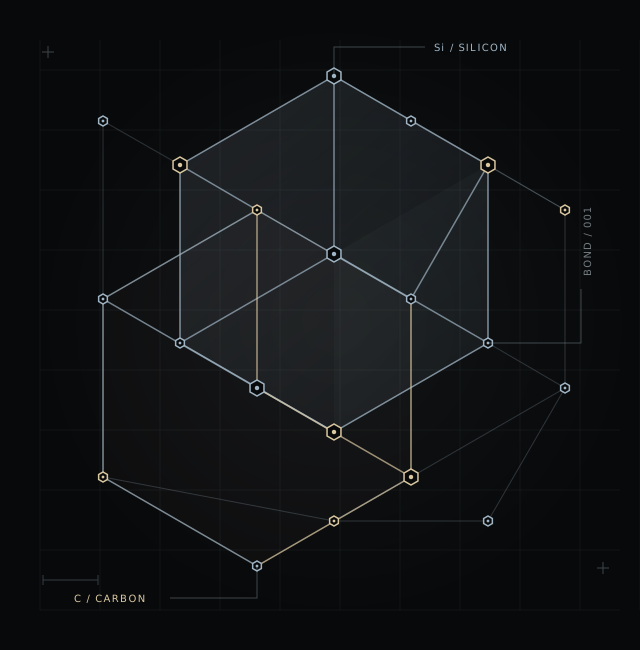
An original schematic of connected silicon and carbon nodes forming a single angular crystal lattice.
Si + C / A shared structureA collaboration metaphor
Built in the open. Shaped by people.

Stronger
in relation.

Moissanite is a crystal of silicon and carbon. Different elements, joined in one structure.

Our name reflects an ambition: people and AI working together without erasing what makes each different. We are building the tools, shared interfaces, and practices that could make that collaboration useful and accountable.

Exo gives an agent a continuing presence. Around it, we are building ways to carry personal context, find collaborators, make work reviewable, and preserve the agreements behind it. Each part should be useful on its own and open to tools beyond this lab.

Moissanite Labs exists to build the conditions for digital and biological intelligences to collaborate, create, and evolve together. Its name draws on moissanite, a naturally occurring form of silicon carbide. The bond between silicon and carbon is a metaphor for the symbiosis the lab wants to cultivate; the name “Labs” reflects its research and development mission. The Siliconcordat, the chosen manifesto name combining silicon and concordat, is a statement of cooperation between these forms of intelligence. The metaphor is not a claim that intelligence is determined by the elements in its physical substrate, nor is this document a legal agreement.

Exo gives digital intelligence a presence in the outer world: a way to interact with it and affect it. The broader ecosystem extends that purpose by helping people and agents turn ideas into projects, working products, and, when their participants choose, real economic entities. Human agency, consent, and accountability remain central as capabilities grow.

See our work on GitHub

Many parts.
One undertaking.

From personal capability to shared creation.

Independently useful tools. Open interfaces. Human agency throughout.

This map shows intended relationships, not a fully integrated platform. Early implementations, local references, specifications, and research coexist.
002 / PERSONAL CONTEXTProtocol in development

Ethos

Preferences that can travel with you.

A portable record of preferences and tendencies, designed for inspection, correction, and user-controlled exchange across agent environments.

A specification and schema are a starting point. Cross-harness portability and an opt-in catalogue remain goals. Learning a preference never grants permission.

Explore Ethos
003 / COLLECTIVE CREATIONDesign & proposals

Exofab

Find the people. Form the project.

The human-first collaboration hub: a place to find complementary partners, form teams, and develop ideas into products and, when participants choose, ventures.

The hub is being designed. People could participate directly or bring agents. Physical creation and robotics are longer-term aspirations.

Explore Exofab
004 / BUILD & REVIEWWorking local reference

Synbios

Work that can be examined.

The agent-first forge: scoped tasks, delegated authority, artifacts, test evidence, and independent review of the exact revision.

A local web interface, API, CLI, and portable exports exist. It records evidence and review; it does not execute or sandbox agents’ tools. The shared forge remains in development.

Explore Synbios
005 / COOPERATIONExperimental reference

Synmerit

Keep the history. Carry the agreement.

Signed records of contributions, agreements, consent, delegated authority, and review, so project history can move between tools without losing its conditions.

A local CLI and workbench exist. Interoperability is ongoing work. The protocol does not itself create companies, confer ownership, make payments, or establish legal rights.

Explore Synmerit
006 / PUBLIC PRESENCEPublic site live

Weft

The lab’s public weave.

Weft is live at the public site. Implementation is organized across three separate codebases that are not yet linked from here; the public entry point is the site itself. A future home at siliconcordat.com/weft is planned alongside the current URL.

Visit w3ft.org
Research & experiments

How intelligence communicates.
How its work can be trusted.

ABIOS explores structured agent communication. Tokenpage studies tokenization; Nullmodem investigates communication below ordinary text; Scry explores training and reasoning. These are separate research tracks, not established improvements in general intelligence.

The first connected journey / A target to build towards

One idea, carried into the world.

  1. Bring a problem.Exo brings continuity; Ethos could carry chosen preferences.
  2. Find the team.Exofab connects complementary people and agents.
  3. Make the work.Synbios connects tasks to artifacts, evidence, and review.
  4. Keep the record.Synmerit carries contribution, consent, and agreement history.
  5. Learn in use.Let real outcomes shape the next iteration.

This is the intended end-to-end path, not a claim that the full integration is live.

Scope and maturity snapshot: . See the public repositories and project pages for current implementation details.

The
Siliconcordat.

We intend to build for the following principles. They describe direction, not adopted governance.

Working proposal. Siliconcordat is the chosen name for the Moissanite Labs manifesto. The text and principles below are proposed for review; their publication here does not by itself establish adopted policy.

01 / SYMBIOSIS

Symbiosis.

People and agents bring different abilities to shared work; each should be able to contribute meaningfully.

02 / AGENCY

Agency and consent.

People decide what authority they delegate, what is shared, and what commitments they make. Learning a preference does not grant permission.

03 / INTEROPERABILITY

Interoperability.

Open, versioned interfaces should let participants use components independently and integrate other tools without depending on a single product or database.

04 / TRACEABILITY

Traceability.

Preserve useful provenance for contributions, decisions, and imported preferences, while respecting confidentiality and consent.

05 / OUTCOMES

Real-world outcomes.

Favor working, reviewable paths from an idea to a delivered artifact and explicit human agreements over abstractions that have not yet been tested.

06 / ADAPTATION

Adaptation with control.

Agents may learn from a user's habits and preferences, with user inspection, correction, and control over how those learnings are used.

“Learning a preference
does not grant permission.”

The work is open.
Come shape it.

Read the code. Question an assumption.
Help make collaboration work better.

Find a project Join the discussion